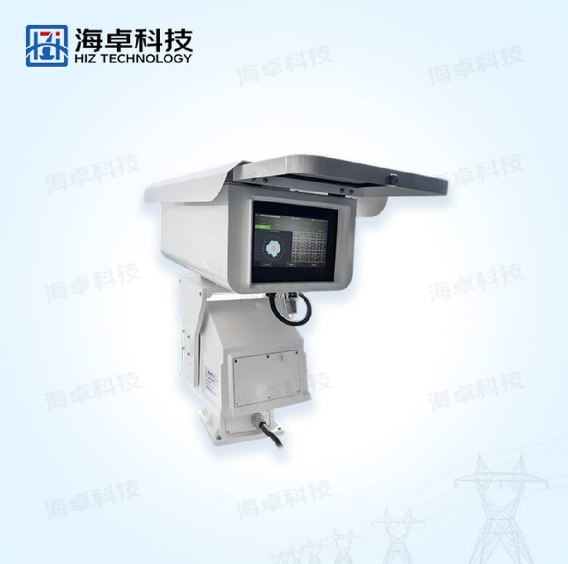
In the field of power transmission operation and maintenance, hazards such as tree encroachment, external damage, and changes in sag have long been persistent threats to the safety of power grids. Traditional monitoring devices either can only provide two-dimensional imaging and cannot accurately measure distances, or are greatly affected by weather and light conditions and fail at night, making it difficult to meet the demands of precise operation and maintenance. The HIZ-SD-SJG laser radar point cloud fusion online video monitoring device launched by Guangxi Haizhuo Technology has integrated multiple technologies to equip transmission lines with "intelligent stereoscopic eyes", completely solving the pain points of traditional monitoring.

The core of the laser radar online video monitoring device lies in the triple integration of laser radar, high-definition video, and AI edge computing, achieving a dual breakthrough of "two-dimensional visualization and three-dimensional precision". The laser radar module generates millions of point cloud data through non-repetitive scanning, conducting centimeter-level three-dimensional mapping of the transmission channel, precisely constructing digital twin models of conductors, trees, and terrain, equivalent to establishing a millimeter-level stereoscopic archive. The high-definition video module simultaneously captures day and night images, identifying dynamic hazards such as construction machinery, fire, and foreign objects. Point cloud data and video pixels are bound in real time, making it possible not only to "see" the hazards but also to "measure" them accurately.
Unlike single-sensor devices, the HIZ-SD-SJG has three core advantages: first, it can operate stably around the clock. The laser radar is not affected by rain, fog, sand, dust, or darkness, and when combined with night vision video, it enables 7×24-hour continuous monitoring, completely solving the problem of traditional cameras failing at night or in bad weather; second, it can accurately identify and warn of hazards. The edge computing unit compares historical and current point clouds in real time, automatically calculating parameters such as tree-line distance, conductor sag, and clearance of construction equipment. Once these parameters approach the safety threshold, it immediately issues alerts at different levels, with response times in the seconds, without relying on the cloud; third, it covers all scenarios. It can simultaneously monitor multiple hazards such as tree growth, external construction, terrain changes, and conductor sag, combining qualitative identification with quantitative analysis.
In practical applications, the device does not require power outages for installation or high-altitude operations, and is suitable for complex scenarios such as mountainous areas, suburban areas, and construction-intensive areas. Previously, manual inspections required traversing mountains and valleys and took several days. Now, the three-dimensional scene and precise data can be viewed in real time from the back-end. The traditional "periodic general clearance" of tree encroachment has been transformed into "on-demand precise clearance", significantly reducing operation and maintenance costs. Additionally, the device supports solar + battery power supply, with a low-power design ensuring long-term stable operation in the wild, and data encryption transmission ensuring security and reliability.