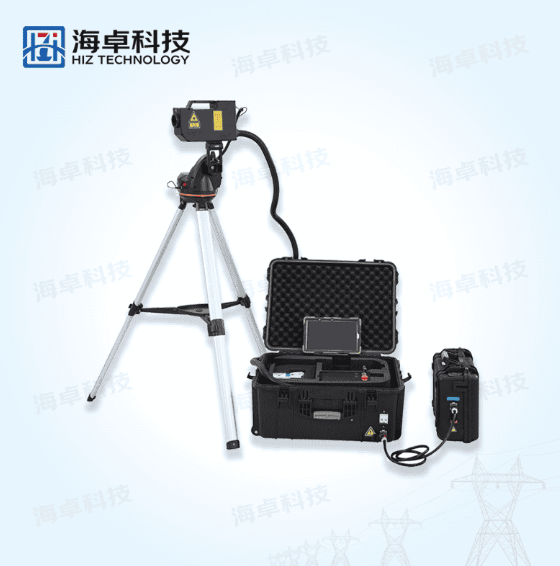
In the operation and maintenance of high-voltage power grids and high-speed railway catenary systems, non-metallic floating objects such as kite strings, plastic films, and fast-growing tree branches constantly pose a threat to power supply safety and line stability. The HIZ-NT-QZY laser obstacle removal device developed by Guangxi Hai Zhuo Technology, with high-energy laser technology at its core and relying on the precise thermal effect principle, has become a "minimally invasive tool" for live-line obstacle removal in power grids.

The core principle of the HIZ-NT-QZY laser obstacle removal device is the precise and controllable application of the thermal effect of high-energy lasers. Relying on three key processes - photoelectric conversion, beam focusing, and targeted action - it achieves non-contact remote obstacle removal. The device is equipped with a high-power fiber laser as its energy core, which can efficiently convert electrical energy into high-energy near-infrared laser at the 1064nm wavelength, with an electro-optical conversion efficiency exceeding 35%, balancing high energy output with low energy consumption. This wavelength of laser has a unique selectivity: non-metallic foreign objects (such as plastic, wood, nylon, etc.) will be highly absorbed, while metal wires will be completely reflected, ensuring that the obstacle removal process does not damage the line itself from a physical perspective.
During the beam transmission and focusing stage, the laser is conducted through optical fibers to the optical system. It is compressed in divergence angle by a precise lens group, and combined with an intelligent pan-tilt and a machine vision magnification system with focusing capability, the laser beam is precisely focused into a millimeter-level spot. Within an operating distance of 30 to 300 meters, the aiming accuracy reaches the millimeter level. At 150 meters, the spot size is only φ15mm, with highly concentrated energy density. Operators can clearly lock onto high-altitude foreign objects from a safe area on the ground through a visual screen, achieving "point-to-point" precise aiming and eliminating the risk of mis-irradiation.
When a focused laser beam is directed at foreign objects, the energy is absorbed instantly, causing the surface temperature of the object to rise to over 3000°C within milliseconds. This rapid increase in temperature leads to carbonization, melting, or vaporization reactions, causing the object to lose its structural strength and fall off naturally. The entire process does not require contact or power outages, and can clear one obstruction in just a few minutes, completely avoiding safety hazards such as falling from heights or electric shock. At the same time, the equipment is equipped with multiple safety mechanisms such as tilt angle sensing to prevent tipping over, safety distance warning, and automatic light-off when personnel intrude. It is also equipped with an efficient air-cooled heat dissipation system, which can adapt to harsh outdoor environments such as high temperatures and sandstorms, ensuring stable operation throughout the day.