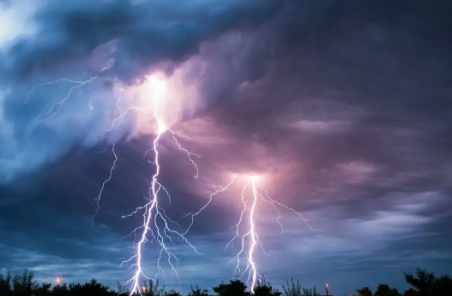
As the lifeline of energy, the power grid is vulnerable to the high-energy nature of lightning, which can cause damage to the system's safety in multiple dimensions. The main manifestations are as follows:
1. Dual physical damage from direct and induced lightning
Direct lightning: With an instantaneous voltage of up to hundreds of millions of volts, it can melt conductors, puncture insulators, and burn out core components of equipment when it strikes transmission lines, towers, or substations. It can even cause tower collapses and line breaks, leading to regional power outages.
Induced lightning: Accounting for about 90% of lightning-related power grid accidents, it does not directly strike the lines but the strong electromagnetic field around the lightning can induce high voltages on conductors, causing flashovers and short circuits at weak insulation points, triggering false alarms of protection devices, and damaging sensitive electronic equipment.
2. Chain damage from overvoltage and lightning waves
The instantaneous overvoltage caused by lightning can travel long distances along power lines, forming lightning waves. These waves can be reflected and intensified at impedance mismatch points such as transformers and cable joints, further breaking down equipment insulation and causing short-circuit faults. At the same time, overvoltage can degrade power quality, leading to voltage sags and flickers, which can cause irreversible damage to precision control and communication systems, trigger chain failures, and expand the scope of power outages.
3. Dual pressure on operation and maintenance safety and costs
After a lightning strike, operation and maintenance personnel need to walk tens of kilometers of lines to inspect, which is time-consuming, labor-intensive, and risky. Equipment damage and power outage repairs can result in significant economic losses and may also affect the operation of critical infrastructure such as medical facilities and transportation, causing social impacts.
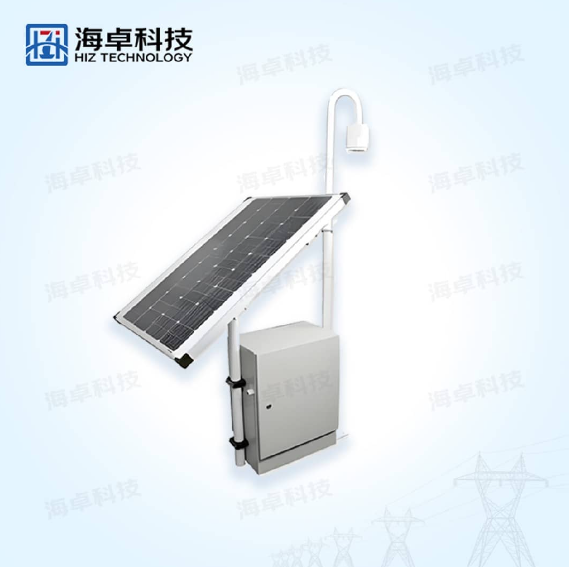
Traditional lightning rods and arresters are passive protection measures that can only mitigate damage after a lightning strike but cannot prevent it in advance. The HIZ-PF-LYJ lightning warning device, on the other hand, provides active warnings to reduce the risk of lightning from the source. Its core value lies in the following aspects:
1. Early warning 5-30 minutes in advance, seizing the golden period for protection
Equipped with a MEMS micro-electromechanical sensor array and seven charge capture needles, it can accurately detect atmospheric electric field fluctuations of 0.1 volts per meter. It can identify risks in the early stage of lightning formation and issue graded warnings (yellow, orange, and red) 5-30 minutes in advance, giving operation and maintenance personnel sufficient time to prepare for protection.
2. Precise risk prediction, reducing equipment damage and power outage losses
By using multi-source sensing and intelligent algorithms, it can predict the time, location, and intensity of lightning, precisely delineating risk areas. It can guide the early activation of lightning arresters, surge protectors, and other protective devices, reducing the probability of insulation breakdown and equipment damage, lowering the line tripping rate, and minimizing power outage duration and economic losses from the source.
3. Ensuring operation and maintenance safety, reducing operational risks
During high lightning activity periods, operations such as high-altitude inspections and outdoor construction are highly susceptible to lightning strikes. Upon receiving a warning, personnel can be immediately evacuated to safe areas, and high-altitude and outdoor operations can be halted to prevent casualties and ensure the safety of operation and maintenance personnel.