Under the backdrop of the global energy transition, wind power generation, as an important component of clean energy, has seen a continuous increase in installed capacity. However, wind power equipment, which is exposed to harsh outdoor environments for long periods, faces numerous risks of failure. Blade damage, bearing faults, gearbox problems, etc., not only lead to a significant drop in power generation efficiency but also may cause prolonged equipment downtime, resulting in high maintenance costs and substantial power generation losses.

The traditional "regular maintenance + post-failure repair" model is no longer suitable for the efficient and intensive operation and maintenance requirements of modern wind power. Against this background, Guangxi Hizhuo Technology Co., Ltd. has launched the HIZ-GE-FYJ wind power prediction and early warning operation and maintenance system based on artificial intelligence technology, providing a brand-new intelligent solution for the reliable operation of wind power equipment.
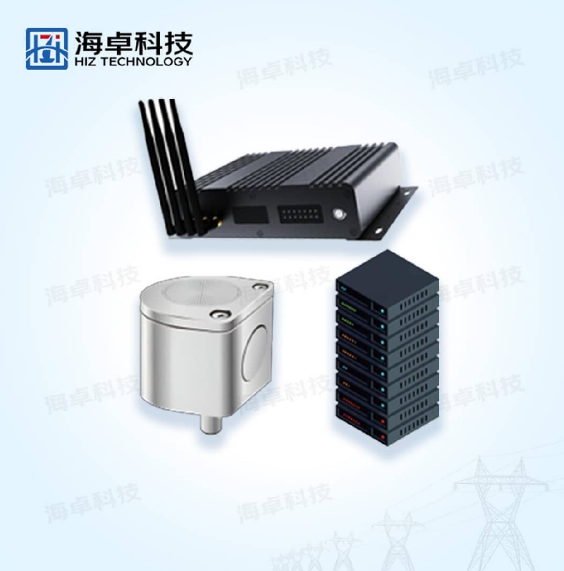
The HIZ-GE-FYJ wind power prediction, warning and operation and maintenance system is not a single software, but an integrated monitoring system combining software and hardware. This system deeply integrates acoustic perception, edge computing and cloud big data analysis technologies, building a complete closed loop from data collection to intelligent diagnosis. The system consists of ultrasonic sensors, edge computing terminals, local servers, network switches, cloud services and other components. Ultrasonic sensors are installed around the wind turbine blades to collect acoustic signals. The edge computing terminals preprocess and extract features from the signals. Local servers and cloud services are used for data storage and analysis, and network switches are used for data transmission. All modules work together to ensure the accurate flow and efficient processing of data.
Product Functions
1. Real-time Monitoring and Fault Warning
It can monitor wind turbine generators in real time without the need for shutdown. By collecting acoustic signals through ultrasonic sensors, it is sensitive to early minor damage. The system automatically judges faults, and experts review them. When abnormalities are detected, it promptly issues alerts. Functions such as abnormal sound traceability and abnormal warning can be displayed in the background.
2. Data Processing and Analysis
It preprocesses (emphasizing, framing, windowing, etc.) and extracts features (time-frequency domain, amplitude, cepstrum, waveform, zero-crossing rate, wavelet analysis, kurtosis, etc.) from the collected acoustic signals. Through multi-dimensional analysis, it compares abnormal sample data with existing known fault features to make fault judgments.
3. Solidification of Expert Experience and System Growth
It can solidify the experience of operation and maintenance personnel in the system. As it continuously learns new sample data, the system can continuously grow and improve the accuracy of fault diagnosis.