Transmission lines serve as the core medium for power transmission in electric power systems, and their operational stability and reliability directly determine the overall power supply quality of the grid. These lines are typically routed across mountains and rivers, laid out entirely outdoors over vast distances, making full manual inspection time-consuming and prone to blind spots. Due to their high voltage levels, transmission lines are highly sensitive to environmental factors such as air conditions, trees, foreign objects, and weather disturbances—minor external forces or environmental changes can trigger discharges, flashovers, or short-circuit faults, resulting in extremely low fault tolerance and inherently high-risk, hard-to-control operating characteristics.

Long-term outdoor operation exposes transmission lines to various natural disasters and external damages:
1. Lightning strikes: The primary cause of tripping in high-voltage lines. Direct or induced lightning can generate transient overvoltages, leading to insulator flashovers, single-phase grounding, or momentary tripping. Faults occur rapidly and cannot be predicted or captured in real time by human operators.
2. Strong wind and external forces: High winds cause conductor galloping and reduced phase-to-phase spacing, triggering interphase short circuits. Wind may also blow down plastic films, kites, debris, or other objects that hang on conductors, causing sudden failures—making this a frequent source of faults during spring, summer, and autumn seasons.
3. Ice accumulation: During cold winter weather with rain and snow, ice builds up on conductors and insulators, increasing line load, reducing sag, and decreasing ground clearance. Ice-induced flashovers and ice shedding-induced jumping can easily lead to cascading failures across multiple line sections.
4. Bird activities (bird-related damage): Birds nesting, perching, defecating, or flapping wings across lines can cause pollution flashovers, single-phase grounding, or momentary interphase short circuits. This is a common, recurring hazard.
5. Various external damages: Includes tree contact, construction excavation, floating debris, vehicle lifting operations, and accidental collisions. These hazards are often hidden and sudden, being the main causes of permanent line faults and power outages due to broken conductors.
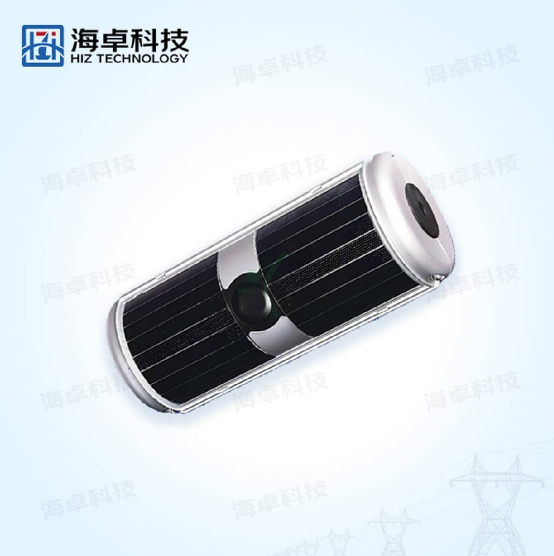
To address the challenges of fault detection in high-voltage transmission lines, Guangxi Haizhuo Technology has developed the HIZ-SD-GFB distributed fault diagnostic device for overhead lines. It is widely applicable to transmission and distribution lines at 35kV, 66/110kV, 220kV, and higher voltage levels. Breaking through the limitations of traditional inspections, the device supports 7×24-hour continuous online monitoring, enabling real-time, precise collection of traveling wave signals and power frequency fault signals from the line. All monitoring data is automatically synchronized and uploaded to the backend master station system. Leveraging advanced artificial intelligence and deep learning algorithms, the system can automatically analyze line operating conditions, identify abnormal states, accurately diagnose various types of faults, and quickly deliver complete fault analysis results. It also sends immediate alerts via SMS to maintenance personnel, significantly reducing fault detection and emergency response times, thereby establishing a robust intelligent protection barrier for grid safety and stable operation.
In terms of core performance, the device can precisely detect and record the location of all common fault types—including single-phase grounding, interphase short circuits, line breaks, and sudden transient faults—covering typical failure scenarios in transmission lines. Its fault section localization reliability exceeds 99%, accurately pinpointing faulty segments with an end-point positioning error controlled within 300 meters, effectively solving the problems of blind and inefficient manual inspections.
Additionally, the device features powerful intelligent fault recognition capabilities, accurately distinguishing between lightning-caused and non-lightning-caused faults with an accuracy rate exceeding 95%. For lightning faults, it can further differentiate between direct strikes and backflashover events, achieving identification accuracy above 90%. With its high precision, comprehensive coverage, and intelligent monitoring and diagnostic functions, this device enables a transformation in grid operations—from passive, manual fault排查 to proactive, intelligent prediction—significantly enhancing the refinement and intelligence level of transmission line maintenance. It effectively reduces fault trip rates and ensures safe, stable, and efficient grid operation.